Felipe Luis Salgueiro / From scattered information to decisions: data and AI with Jev
From scattered information to decisions: data and AI with Jev
Learn to organize data, frame business questions and use Jev to classify, score and support decisions with verifiable criteria.
October 7, 2026 · NoCode Startup · approximately 113 min
A lesson about turning messages, spreadsheets and records into decisions. Start with the business problem, prepare the information and define the role of each part: people, code, LLMs and Jev. No programming experience required.
Why this topic
More information does not automatically bring clarity. Volume, speed, variety, quality and usefulness affect what we can decide.
Before choosing a model, define the question, the criteria and the action that could change with the answer.
Lesson and workbook
Adapted from the revised 25-page workbook. Captions distinguish original slides from supplementary teaching materials. The recording is in Portuguese and exclusive to NoCode Startup students.
Felipe Luis Salgueiro · Marketing Engineer and GTM Builder.
What you learn
Frame a business question and identify the necessary sources.
Understand databases, APIs and Bronze, Silver and Gold layers.
Distinguish Choice, Score and Noul, including scores versus probabilities.
Separate interpretation, validation, execution and human responsibility.
What you can apply
Map a decision flow from original records to measured outcomes.
Define categories, criteria and an insufficient-information outcome.
Choose what code must check and when a person must review.
Test a small case before expanding automation.
From question to decision
01
Start with the business question
“How satisfied are my customers?” helps select sources: support messages, surveys, public reviews and order records. A rating alone does not explain what happened. Connect numbers and accounts of the same case.
A CRM organizes contacts and commercial history; an ERP supports operations. Forms, campaigns and social media add signals. Identify the source, date and related record before drawing conclusions.
Original Portuguese slide 01, workbook page 4. The business question determines what deserves attention.
02
Priority means criteria applied to context
Who gets the first reply: an immediate buyer, a price question or a delayed order? The order depends on goals, urgency and impact. During a delivery crisis, protecting customer relationships may matter most; during a launch, an immediate purchase may change the priority.
The cycle is receive → organize → understand → decide → act → measure → learn. Recording that automation ran is not enough. Observe the effect of the decision and adjust the next cycle.
03
Let the problem guide the architecture
Data consists of records; databases store and retrieve them; architecture connects the parts; APIs define how systems exchange requests and responses. Automation executes tasks under rules. Each component needs a clear role.
Start with hypotheses, questions and requirements. Relational databases connect records; document databases accommodate varying formats. PostgreSQL also supports JSON. Consider queries, transactions, access, cost, backups and maintenance. The Python-to-Rust example is a report about one component, not a universal rule.
04
Bronze, Silver and Gold: preserve provenance
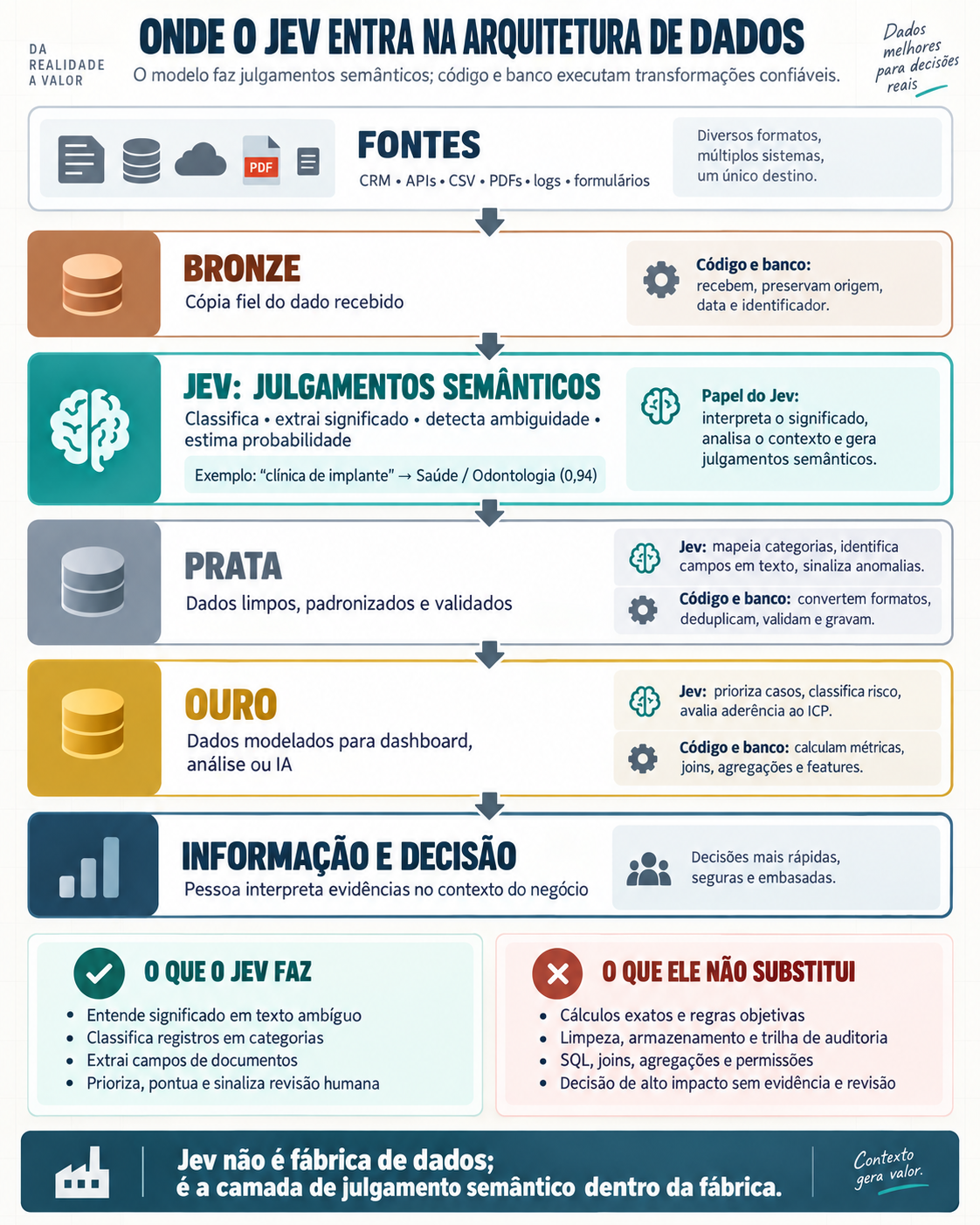
Bronze preserves original messages and events. Silver cleans and relates records. Gold prepares information for a specific question, such as cash-flow indicators. Small projects can also use this approach.
Jev can support semantic judgments at different stages. The application prepares and supplies the data; the model does not replace SQL queries, calculations, cleaning or storage. Keep the original evidence so conclusions remain traceable.
Author-approved supplementary infographic in Portuguese. The 0.94 value is illustrative, not a measured result; Jev does not replace code, SQL or human review.
05
People, code, LLMs and Jev
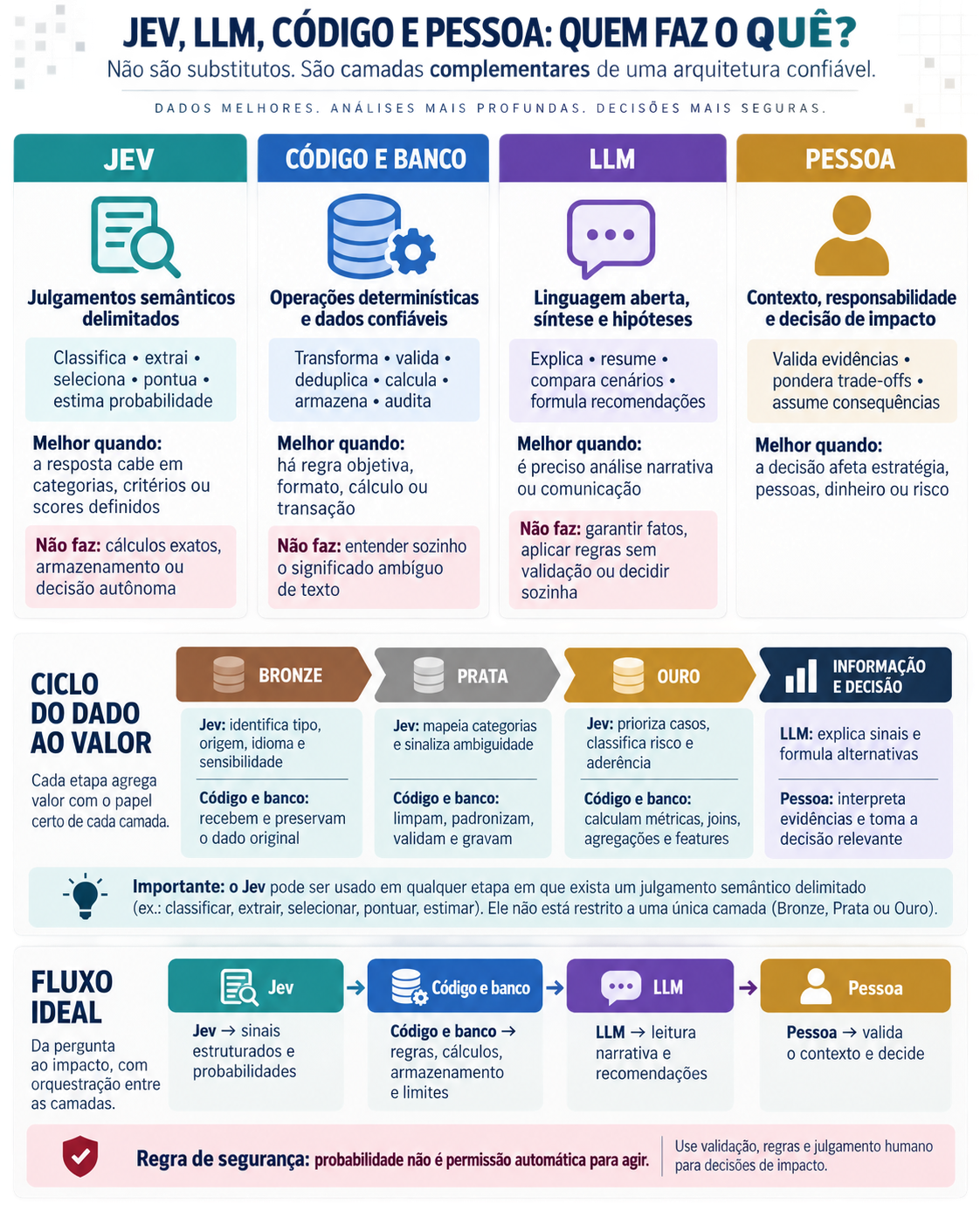
People define goals, criteria and responsibility. Code calculates, validates, checks permissions and executes. LLMs work with language and can gather context through authorized tools. Jev, by TypeSafe AI, evaluates questions with bounded answers.
The System One analogy introduces the product concept. It is not a literal account of the mind or a technical classification of every LLM. A structured answer can have a valid format and still be wrong in meaning.
Author-approved supplementary infographic in Portuguese. The flow is one architecture option; evaluation does not grant permission to act.
06
Choice, Score and Noul
Choice selects among described categories and returns a choice, probabilities and confidence. Include an insufficient-information category when useful. Score places a case on described levels: with levels 0, 1 and 2, a result of 1.4 is a position on that scale, not 140% or a probability of correctness.
Noul estimates the probability of yes for a proposition, from 0 to 1. The application turns that estimate into a decision using tested rules and thresholds. “Is the customer dissatisfied?” and “Do they want to cancel?” require separate judgments. Input state can be text, a list or a JSON object.
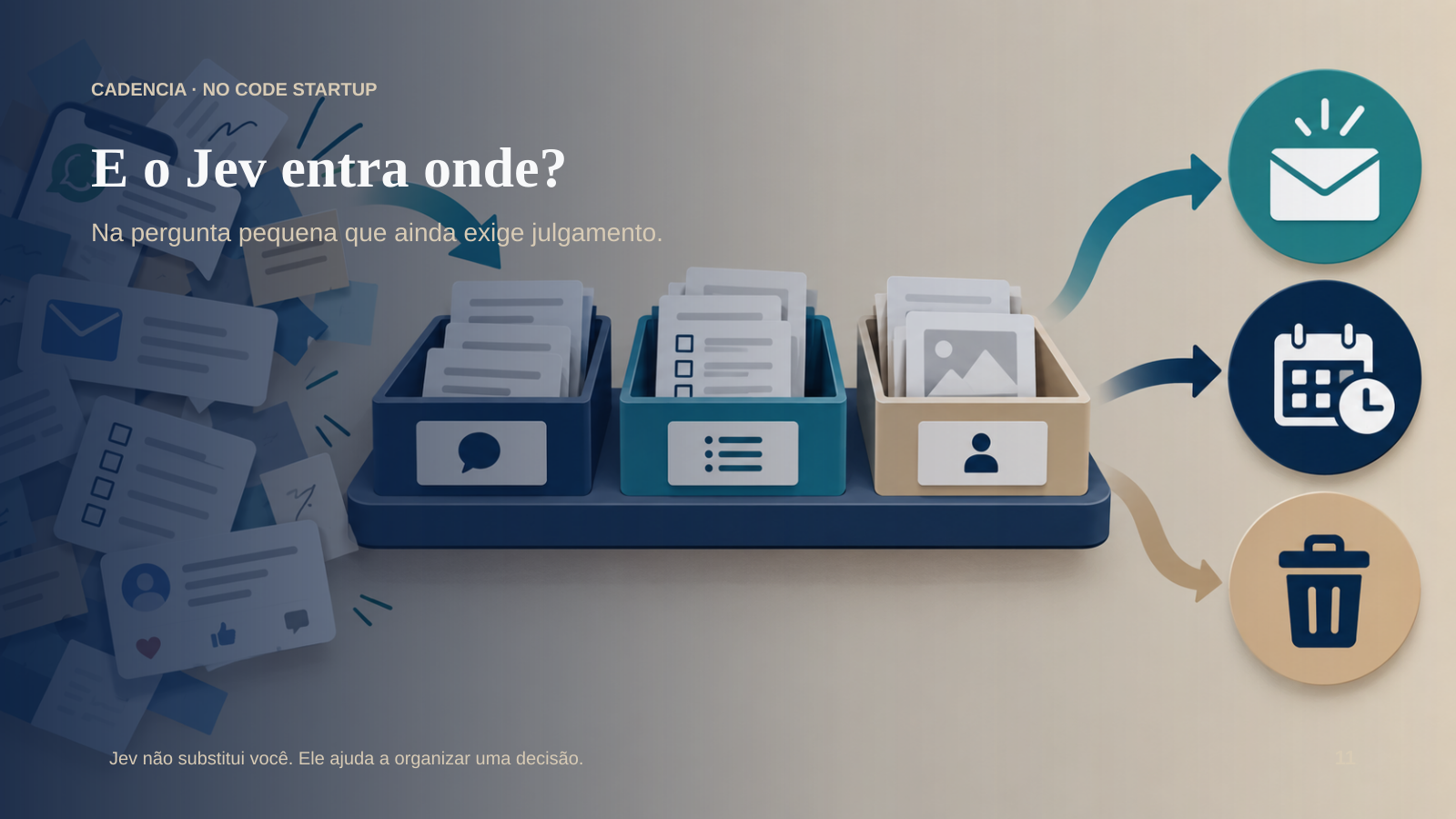
Slide 11, workbook page 12. These are possible actions; classification does not authorize execution or deletion.
07
From context to a permitted action
The lesson combines an LLM to prepare context, Jev to evaluate it and code to control the action. The LLM is optional: an application can call Jev directly through the API. Integration depends on the problem.
Thresholds such as 0.8 are examples, not universal settings. Test known cases, assess the cost of errors and define what happens when data is missing or results are uncertain. A classification alone does not authorize sending, deleting or publishing.
08
Leads, skills and delivery checks
An email click indicates engagement, not necessarily purchase intent. Define categories and compare judgments with actual replies, proposals and sales. For skill routing, select among available capabilities, then validate inputs and permissions before execution.
A PRD records product requirements, an RFC discusses a technical proposal and an ADR records an architectural decision. Semantic evaluation may identify gaps between requirements and delivery. Tests still need to run and evidence must exist. Limit correction attempts and route uncertainty to review.
09
Decide what is worth keeping
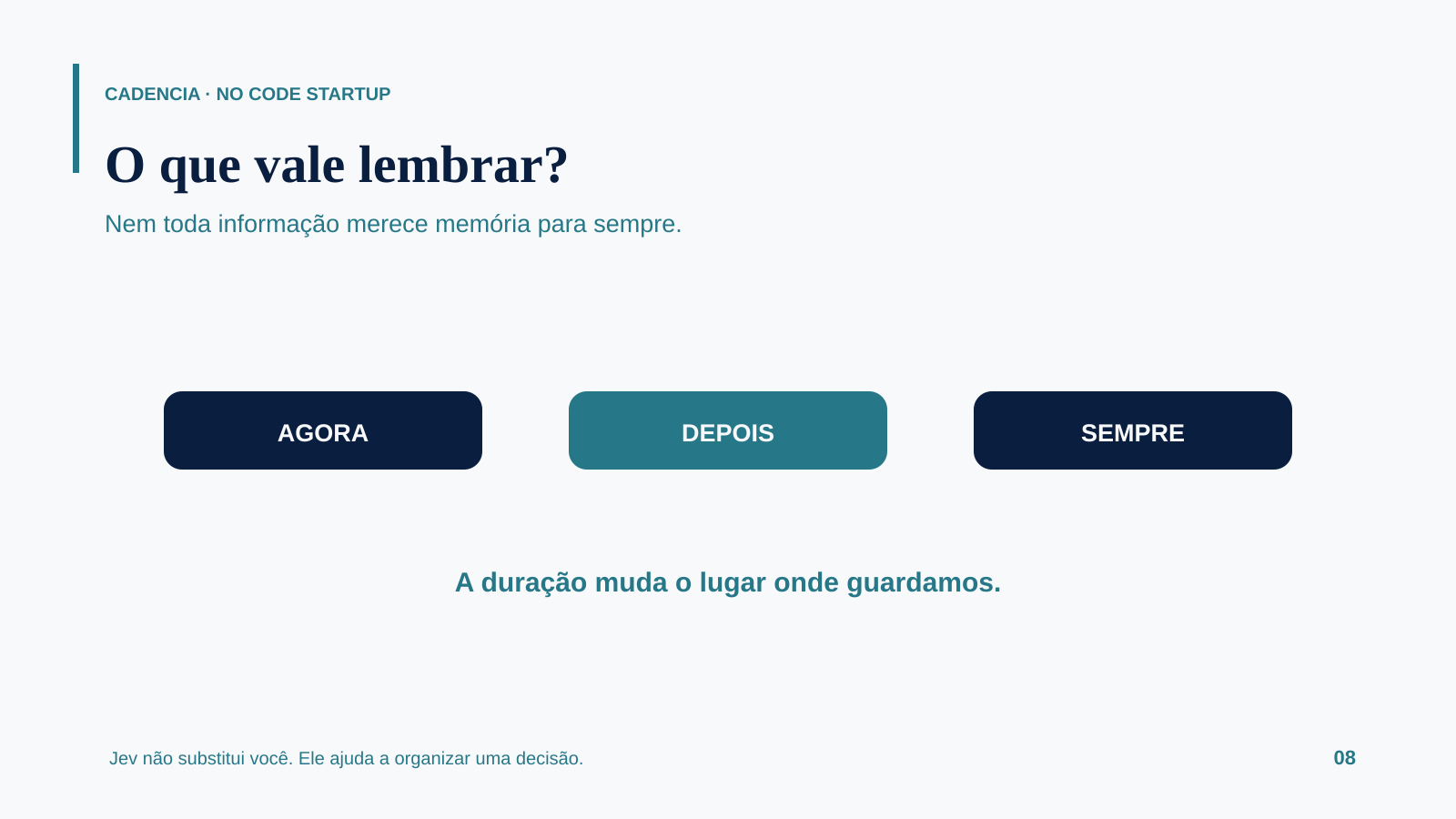
Separate context useful now, information needed later and durable knowledge that remains open to revision. The lesson describes classifying memories to retrieve relevant information instead of rereading the full history. Performance figures are reported examples without a detailed comparative benchmark.
When instructions compete, the team must define precedence and applicable context. “Reply quickly” does not establish when checking the data should come first. Without a clear rule, the system should request guidance.
Slide 08, workbook page 18. Durable knowledge remains subject to revision, purpose and retention rules.
10
Probability, confidence and control
A probability of 0.9 does not demonstrate 90% accuracy on your cases. Confidence summarizes probability concentration in Choice and Score; a model can be confidently wrong. Validate on examples from your context and record errors and versions.
Calculations, dates, permissions, transactions and critical operations require explicit rules, tests and authorization. MCP connects tools and data through a common protocol; connection does not grant unrestricted access. When a simple rule works, extra AI may be unnecessary.
Workbook exercise · page 21
Design your first flow
Choose a real task and answer these six questions before selecting a tool. Use your answers to discuss a small test with your team.
The decision
What action is needed, who owns it and which outcome should improve?
The data
Where will information come from and how will records of the same case be linked?
The criteria
What makes a case take priority, and when does that change?
The evaluation
Do you need a category, a position on a scale or a yes/no proposition?
The controls
What does code check, and when does a person need to decide?
The measurement
Which outcomes, errors and costs will show whether the change helped?
Terms to revisit
API
An agreed interface for exchanging data and requesting operations.
JSON
A data format: objects contain fields; arrays are ordered lists.
LLM
A language model that generates and interprets text.
RLS
Policies controlling access to database rows.
ACID
Atomicity, consistency, isolation and durability in transactions.
MCP
Model Context Protocol: a standard for connecting tools and data.
Study sequence
Information and priority
Questions, context, criteria and the learning cycle.
Systems and data
Architecture, cost, maintenance and preparation layers.
Jev and structured responses
Choice, Score, Noul, inputs and output interpretation.
Applications and limits
Leads, skills, memory, requirements and execution controls.
Guided practice
A workbook exercise for designing your first flow.
Further reading
The workbook distinguishes classroom reports, teaching diagrams and the technical revision dated October 8, 2026. Consult these references to check contracts before implementation.